





Data containing the following lexical sets were collected for A Sound Atlas of Irish English. Most of the lexical sets are those which are required for standard English. However, a number of additional ones were also included in order to handle the specific features of Irish English. For instance, data on the rhotic vowels of Irish English was obtained by checking the pronunciation of those words which contain an historic /r/ after a vowel within a single syllable. For the purposes of the present investigation the lexical sets DANCE and the lexical set PATH were kept apart although for most varieties of British English these can be collapsed.
In Irish English the area of coronal obstruents, stops and fricatives between the dental and palatal points of articulation, is particularly crucial. For that reason a number of items in the sample sentences attempt to record specific instances of these segments.
The following sentences were used when gathering phonological data. Speakers were asked to read the sentences in their normal accent at their usual speed. The words illustrating the lexical sets were not highlighted. After this reading, speakers were then asked to read a list of words (illustrating the lexical sets) at a normal speed and at a slower speed, i.e. in word-list style. Illustrations for the lexical sets were thus gained for all speakers in the following three contexts: 1) embedded, normal; 2) isolated, normal; 3) isolated, slow. The acoustic data thus gathered was digitalised and stored as audio files. Some of these can be listened to by clicking on the locations indicated on the county maps, consult section Sound files in the Access menu.
Short vowels
1) They bought a KIT to make beer.
Long vowels
7) I suppose they'd FLEECE you.
Rising diphthongs
13) The PRICE has gone up again.
Centring diphthongs
18) It's NEAR the modern station.
Rhotacised vowels
21) The film should START soon.
Unstressed vowels
26) There's a LETTER for you today.
Low vowels before (i) nasal + obstruent, (ii) voiceless fricatives
29) She's learning how to DANCE.
Consonantal lexical sets
31) I THINK it's time to go.
Additional test sentences used during data collection
49) That wasn't VERY FAIR. /-eri, -e:r/
 Lexical sets used for recording Irish English
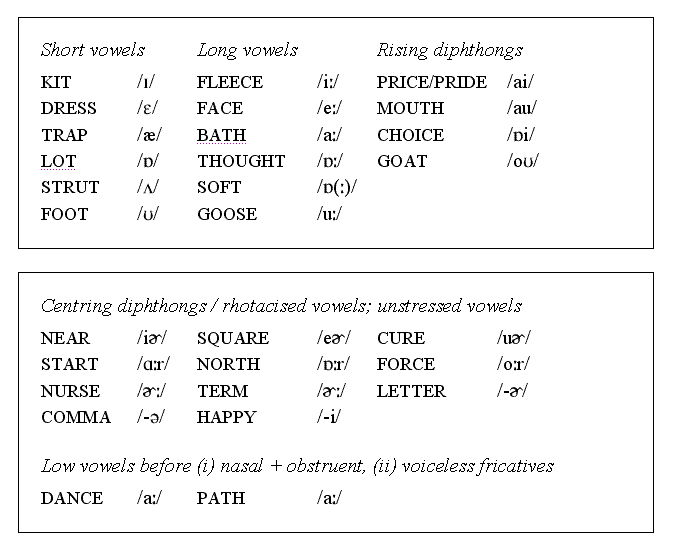
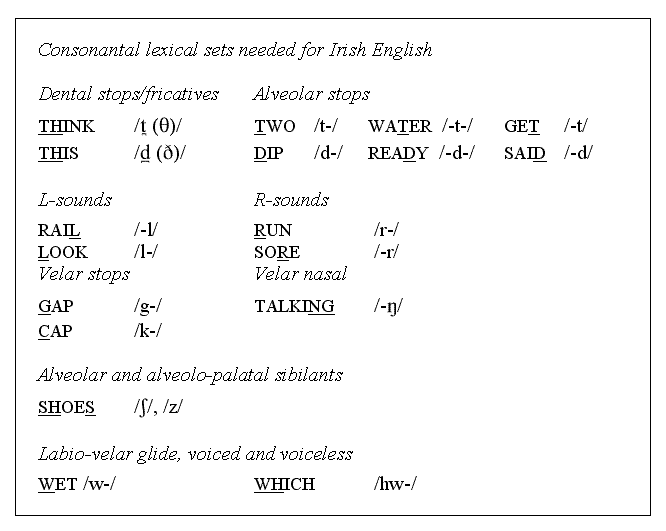
2) She bought herself a new DRESS.
3) They walked into the TRAP.
4) There're a LOT of people outside.
5) He CUT the piece of twine.
6) He put his FOOT in it.
8) You have to put a brave FACE on it.
9) They bought a new BATH last week.
10) Spare a THOUGHT for your parents.
11) You should go SOFT on him.
12) They kept a GOOSE in the back yard.
14) They're the PRIDE of the nation.
15) The city is at the MOUTH of the river.
16) The CHOICE was the right one.
17) They had a GOAT on their farm.
19) Down by the town SQUARE.
20) There is a CURE for that now.
22) He's travelling up NORTH.
23) The FORCE of the wind increased.
24) Ask the NURSE for water.
25) The prison TERM was quite long.
27) Put a COMMA after that word.
28) I suppose they're HAPPY now.
30) We took a different PATH.
32) Now BREATHE in slowly, please.
33) There're TWO of them there.
34) They've gone for a DIP.
35) They've a new WATER supply.
36) Are they READY now?
37) Will you GET another chance?
38) She SAID she was coming.
39) Take a LOOK at the car.
40) The RAIL track is overgrown.
41) You'll have to RUN for the bus.
42) My back is very SORE lately.
43) There is a GAP in the field.
44) He put his CAP on.
45) He was TALKING about his wife.
46) She took her SHOES off.
47) The whole floor is WET.
48) WHICH one do you mean?
50) It's just his STYLE. /-ail/
51) We haven't any TIME. /-aim/
52) They REALISED the problem. (word stress placement)
53) We live in IRELAND. /air-/
54) All of us are IRISH. /air-/
