


Language in perspective
Characterising language
• Linguists vary in their definitions of language. However, all agree that language is a system of vocal signs with an internal structure and used for the purposes of human communication. Language usually has a secondary function of carrying a social message.
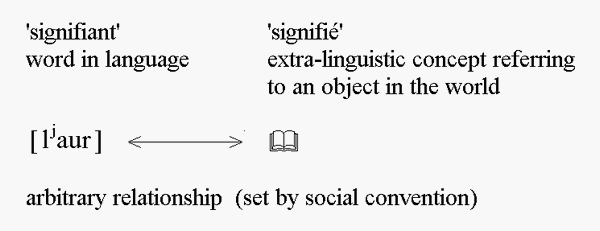
• The relationship between signs and what is symbolised is arbitrary but fixed by social convention. The system is stimulus-free and non-random. It shows a duality of structure in having building blocks (phonemes) and units consisting of these (words). A small number of building blocks permits a large number of meaningful units.
• Languages vary greatly in their form and this has led some linguists to imagine that one's native language determines the way one thinks. This extreme opinion is rejected nowadays.

Characterising linguistics
• The goal of linguistics is to provide valid analyses of language structure. Linguistic theory is concerned with establishing a coherent set of independent principles to explain phenomena in language.
• There are no primitive languages. Each language is adapted for the community which speaks it, be this industrialised or not.
• Onomatopoeia is not a major principle in language although symbols (icons) may be present on a more abstract level.
• There is no such thing as correct language in any absolute sense. Language is neutral and should not be the object of value judgements. Lay people tend to confuse language and attitudes to those who use language.
• Written language is secondary and derived from spoken language. Despite its status in western societies, written language is only of marginal interest to the linguist.
• Linguistics is a science although the evidence for assumptions about the structure of language is never direct. Linguists are more concerned with designing valid and general models of linguistic structure rather with than searching for proof in any strictly empirical sense.
• Language consists largely of rules which determine its use. There are, however, many exceptions. Native speakers can deal with a large amount of irregularity which is stored in the mental lexicon.
• Knowledge of language refers to many abstract structures such as those of sentence types or systematic units such as phonemes or morphemes.
• Language would appear to be ordered modularly, i.e. to consist of a set of subsystems, which are labelled 'levels of language', such as phonology, morphology or syntax.
• Most knowledge about language is unconscious and cannot be accessed directly. The task of the linguist is often to demonstrate the existence of this unconscious knowledge and to suggest methods of describing it.
On the origins of language
• There is long tradition of speculating about the origin of language. Most of this was and is unscientific as it does not apply stringent principles of historical continuity and interrelations.
• Modern man has existed for about 200,000 years and after 50,000 BC language had developed all the structural properties which are characteristic of it today.
• Language is an evolutionary phenomenon which is continually adapted to the communicative needs of its speakers.
• The organs of speech are biologically secondary but their rise has led to a specialisation such as the great flexibility of the tongue or the relatively deep larynx which distinguishes humans from higher primates.
Structural notions in linguistics
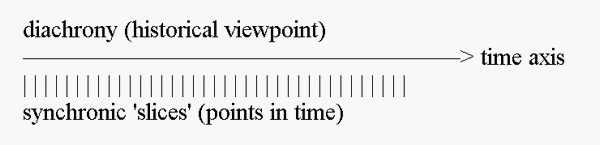
• Language can be viewed at one point in time — synchronically — or over a period of time — diachronically.
• There is a significant distinction between the act of uttering language — parole/performance — and the system of a language which can be seen as the abstract ability of the single speaker to speak his/her native language — competence — and/or the communal linguistic knowledge which defines a speech community — langue.
• Linguists distinguish carefully between the signifiant, the sign which describes/points to a signifié and that which is signified/ designated outside of language.
• Linguistic levels can be classified according to which they are open, like the lexicon, and can take on new elements or closed, like phonetics and morphology, which cannot be expanded at will by speakers.
CHARACTERISTICS OF CLOSED CLASSES
• small number of units
• Elements which are common in all languages are unmarked. Those phenomena which occur frequently and which are both found often in language change and turn up early in language acquisition can be called natural.
• The superfluous — redundant — elements of language may turn out to be useful in non-optimal communication situations such as speech in a loud surrounding or at a distance.
Talking about language and linguistic data
• The language one uses to talk about language is termed metalanguage. That which is investigated is called object language.
• There are different methods of collecting object language data: one's own intuitions, elicitation from other native speakers or the use of a text corpus.
The grammatical core
• Word classes — e.g. nouns and verbs — show similarities in their form and the grammatical categories they indicate.
• Grammar is a largely autonomous system with its own rules which need not be motivated by language external considerations, cf. the gender system of German.
• There is some indirect evidence for the reality of rules. This comes mainly from language pathology and the area of speech errors.
Areas of linguistics
Apart from dividing language into various tiers, one can study linguistics from different points of view. Here one is not restricted to a single level so one speaks of a linguistic area. A short list of the most important areas is given below.
Linguistic theory
The history of linguistics is bound up with various theories which have been proposed in the attempt at explaining the nature of the human language faculty. These theories can be grouped into three broad categories which correspond roughly to historical epochs.
• There is a distinction between general and descriptive linguistics, the former being about concepts and the latter about investigating and describing languages.
• Theoretical linguistics develops models of language competence while applied linguistics deals with the uses to which linguistics can be put in practical affairs such as language teaching.
• All languages are divided into levels which are the divisions made according to the status of elements — sounds (phonology), words (morphology), sentences (syntax). In addition one has the level of meaning (semantics) and language use (pragmatics).
• Areas of linguistics are concerned with the approach and scope of a linguistic study. This can for example concern social uses of language (sociolinguistics), the process of learning language (language acquisition), historical processes (language change).
• Various linguistic theories have been developed over the past two centuries. Three main schools can be recognised: Neogrammarianism (late 19th century), structuralism (first half of 20th century), generative grammar (second half of 20th century).
• polyfunctional
• acquired in early childhood
• low or non-existent awareness for lay speakers

1) Sociolinguistics
2) Variety studies
3) Language acquisition
4) Language and the brain
5) Contrastive linguistics
6) Language change
7) Linguistic theory
Orientation
Period
0) non-theoretical studies
before the 19th century
1) historical linguistics
19th century
2) structuralism
first half of 20th century
3) generative grammar
second half of 20th century