


 Who speaks Irish?

Census 2022
Use of Irish and the Gaeltacht
Shifts in language use
How many native speakers are there?
Commissioned study of Irish in the Gaeltacht
20 Year Strategy for the Irish language
Revival movement for the Irish language
The most recent census was carried out in Ireland on 3 April 2022, following the previous one from April 2016 (the next is planned for 2027). There are summary results available on the website of the Central Statistics Office / An Phríomh Oifig Staidrimh but these are not connected with the Irish language. The section for Irish language statistics can be found else in the website of the Central Statistics Office: language statistics.
Who speaks Irish? This is not an easy question to answer given that official figures in Ireland have been unrealistically optimistic throughout the entire 20th century, a period of major decline in native speakers of Irish following on the disastrous nineteenth century. Successive governments in Ireland have been content to publish figures which bore little or no relation to reality. These figures derive from censuses which were carried out roughly every decade (since 1981 the intervals between censuses have been about halved). The problematic nature of census figures can be illustrated by looking at the returns for the ability to speak Irish during the past century and a half.
| Year of census | Irish speakers | Non-Irish speakers |
| All ages | ||
| 1861 | 1,077,087 (24.47%) | 3,325,024 |
| 1871 | 804,547 (19.85%) | 3,248,640 |
| 1881 | 924,781 (23.9%) | 2,945,239 |
| 1891 | 664,387 (19.15%) | 2,804,307 |
| 1901 | 619,710 (19.23%) | 2,602,113 |
| 1911 | 553,717 (17.64%) | 2,585,971 |
| 1926 | 543,511 (18.29%) | 2,428,481 |
| 3 years and over | ||
| 1926 | 540,802 (19.3%) | 2,261,650 |
| 1936 | 666,601 (23.75%) | 2,140,324 |
| 1946 | 588,725 (21.24%) | 2,182,932 |
| 1961 | 716,420 (27.18%) | 1,919,398 |
| 1971 | 789,429 (28.32%) | 1,998,019 |
| 1981 | 1,018,413 (31.56%) | 2,208,054 |
| 1986 | 1,042,701 (31.09%) | 2,310,931 |
| 1991 | 1,095,830 (32.55%) | 2,271,176 |
| 1996 | 1,430,205 (41.1%) | 2,049,443 |
| 2002 | 1,570,894 (41.88%) | 2,180,101 |
| 2006 | 1,656,790 (40.83%) | 2,400,856 |
| 2011 | 1,774,437 (38.67%) | 2,813,815 |
| 2016 | 1,761,420 (36.99%) | 3,000,445 |
| 2022 | 1,873,997 (36.39%) | 3,275,142 |
The above statistics imply that between 1926 and 2006 the number of Irish speakers in Ireland more than trebled. This is plainly absurd. Consider that the census returns were formerly based on self-assessment: individuals were asked if they could speak “Irish only”, “Irish and English”, “Read but cannot speak Irish” and the responses formed the basis of the statistics produced later. The language data were collected by asking the question: ‘Can you speak Irish’; below is the relevant part of the 2006 census questionnaire.
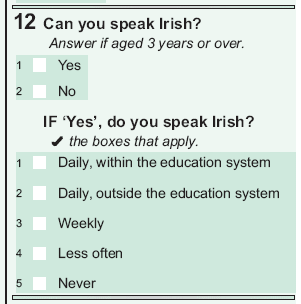
Because there was no checking on the veracity of the claims individuals made, over-reporting became the norm after Irish independence (post 1922) and by the end of the 20th century had reached very considerable proportions and this practice has continued into the 21st century.
The pivotal census of 2006
In the following sections, the statistics displayed are those gained from the 2006 census figures (for the reason given presently). The trends visible in these census figures have continued through subsequent censuses, i.e. in 2001, 2016 and 2022.
On 4 October 2007 Volume 9 of the 2006 census – Irish Language – was published by the Central Statistics Office. Over some 150 pages, consisting mainly of tables, it attempts to document all aspects of the Irish language in contemporary Ireland. This census, however, still claims that over 40% of the population of Ireland have an ability to speak Irish (without any attempt at specifying just what this means):
| Total population | Ability to speak Irish | Non-Irish speakers | Not stated | % of total |
| 3,990,863 | 1,650,982 | 2,242,554 | 97,327 | 42.4 |
However, with regard to gaining reliable figures on the state of Irish in Ireland the 2006 census (carried out on Census Night, April 23, 2006) marks a significant change. This is because a single question was added to the census form (see above), namely whether persons used Irish daily (i) within and (ii) outside the education system. This essential question provided a flavour of reality with regard to the use of Irish in contemporary Ireland. It had long been assumed by observers of census figures that the claim of respondents to speak Irish rests largely on their exposure to the language in school (where the language is compulsory). Needless to say, the level of proficiency attained with a compulsory subject in school can and does vary greatly.
The use of the language on a daily basis outside the education system, which is a good yardstick for any living community language, presents a very different picture. Consider in this respect the following returns.
Persons aged 3 years and over usually resident and present in the State on Census Night, classified by ability to speak Irish.
| Daily within education system | Outside education system | ||||||
| Ability to speak Irish | Speaks Irish within education system only | Speaks Irish also outside education | Daily | Weekly | Less often | Never | Not stated |
| 1,650,982 | 452,925 | 31,567 | 53,130 | 96,716 | 578,779 | 411,043 | 26,822 |
These figures show that of the 1.6 million individuals who claimed the ability to speak Irish, only 3.22% (53,130) actually used it on a daily basis outside the education system. Additionally, the fact that the figure for a weekly use outside the education system is nearly twice as large as for a daily use would imply that this use is very brief, that is there may not be a chance to use the language daily, but one might be able to use it once a week, assuming one can find other individuals one can talk to. Even a reference to using Irish daily outside the education system does not mean that Irish in this case is the language of choice, i.e. preferred over English for all levels of public and private exchange. In sum, the figure of 3.22% for individuals with a daily use of the language outside the education system should not be taken to imply that there is this number of native speakers of Irish in present-day Ireland: this figure contains a significant proportion of second-language speakers.
An interesting result of these statistics is that 70.65% of those who reported an ability to speak Irish never used the language at all. Those who neither speak Irish within or outside the education system total 1,166,490, i.e. just over 70% of the 1,650,982 who claim the ability to speak Irish. So what does the ability to speak Irish mean for this 70.65%? The only answer is that they once learned the language (in school), have not used it since, but view the remnants of their knowledge of Irish as an ability to speak the language. In the census collection situation, where there was no checking of language ability and where the census collector was highly unlikely to have any particular knowledge of the language anyway, this type of claim could be made with impunity.
The relationship between the use of Irish within the education system and outside is more even in the Gaeltacht compared to the urban centres of Ireland. For instance, in Dublin 104,743 persons reported using Irish on a daily basis within the education system while only 6,658 (6%) stated that they also speak Irish daily outside education. In the Co. Galway Gaeltacht, on the other hand, 5,035 persons reported using Irish within the education system on a daily basis with 2,416 (48%) also using the language on a daily basis outside of the education system.
Use of Irish and the Gaeltacht
|
Total population |
Ability to speak Irish |
Daily use outside education |
Entire state |
3,990,863 (100%) |
1,650,982 (41.37%) |
53,130 (1.33%) |
The Gaeltacht |
91,862 (100%) |
64,265 (69.96%) |
17,687 (19.25%) |
| Population of the Gaeltacht areas | 91,862 | |
| Irish speakers | 64,265 | 69.96% |
| Non-Irish speakers | 26,539 | 28.89% |
| Not stated | 1,058 | 1.15% |
The areas designated as the Gaeltacht have always been generously defined by the Irish government. For instance, the 2006 census still maintains that part of Galway city is within the Gaeltacht and returns 13,737 individuals for this area. It is true that many native speakers of Irish (from the Gaeltacht to the west) work in the city, either commuting from outlying locations or living in Galway, but it is not certain whether a part of Galway city constitutes a living community of native speakers of Irish. The census statistics inadvertently confirm this. Of a supposed group of 6,878 speakers only 474 (7%) reported using Irish daily. Compare this with Galway county where the census returned 22,377 speakers with 7,382 (33%) using the language on a daily basis. In addition, the ‘Galway city Gaeltacht’ shows very few speakers of 65 years and over: 375 with 48 using Irish daily. This indirectly confirms that the speakers here are in-migrants from the Gaeltacht area to the west of the city who came in search of work.
A spin-off of the very broad official definition of Gaeltacht is that the census only returned 64,265 Irish speakers among the total Gaeltacht population of 91,862, i.e. only two thirds of persons in the Gaeltacht speak Irish. A more realistic, i.e. smaller, geographical definition the Gaeltacht would yield a higher percentage of Irish speakers, though it would never reach 100% as there are many English-only speakers living in the various Gaeltacht areas.
Use of Irish on a daily basis outside the education system with speakers aged 3 years and over in each Gaeltacht, classified by frequency of speaking Irish and age group (partial).
| Gaeltacht | No. of speakers | Use Irish daily | 15-24 | 65 years plus |
| Donegal | 16,909 | 5,851 | 512 | 1,562 |
| Mayo | 6,853 | 1,031 | 80 | 288 |
| ( Galway city | 6,878 | 474 | 73 | 48 ) |
| Galway county | 22,377 | 7,382 | 851 | 1,266 |
| Kerry | 6,170 | 1,810 | 179 | 339 |
| Cork | 2,860 | 622 | 68 | 126 |
| Waterford | 1,242 | 304 | 39 | 39 |
| Meath | 976 | 213 | 25 | 39 |
| All areas | 64,265 | 17,687 | 1,827 | 3,707 |
Shifts in language use
The dynamics of the current language situation can be recognised by comparing two age groups, which are roughly equivalent in terms of size, for daily use of Irish (see above table). In all the Gaeltacht areas the ten-year age group from 15-24 constitutes about 10% of the speakers who use the language daily. At the opposite end, one can see that the group of individuals over 65 constitutes more than 25% in the larger Gaeltacht areas.
In the weak Gaeltacht areas, such as Waterford and Meath, the figures are closer because the group of older speakers has been smaller for some time, whereas in the stronger Gaeltacthaí, notably in Co. Donegal and Co. Galway, the decline in language use has been more recent and so there is still a sizeable community of individuals over 65 years of age who speak Irish amongst each other on a daily basis.
There is also a significant proportion of speakers of Irish in the Gaeltacht areas who claim never to use Irish. The numbers here are greatest for the 25-34 year age bracket. This would confirm the view that some people who acquire Irish in their homes abandon the language as adults during their professional life.
Use of Irish by Irish speakers outside the education system in Co. Galway (total: 14,364).
| 3-4 | 5-9 | 10-14 | 15-19 | 20-24 | 25-34 | 35-44 | 45-54 | 55-64 | 65+ | ||
| Daily | 7,382 | 147 | 211 | 267 | 385 | 466 | 1,011 | 1,100 | 1,377 | 1,152 | 1,266 |
| Weekly | 1,833 | 33 | 69 | 82 | 116 | 150 | 245 | 354 | 299 | 232 | 253 |
| Less often | 3,964 | 24 | 53 | 78 | 246 | 335 | 721 | 774 | 742 | 494 | 497 |
| Never | 1,185 | 1 | 9 | 19 | 86 | 127 | 264 | 251 | 238 | 104 | 86 |
Use of Irish by Irish speakers outside the education system in all Gaeltacht areas (total: 43,714).
| 3-4 | 5-9 | 10-14 | 15-19 | 20-24 | 25-34 | 35-44 | 45-54 | 55-64 | 65+ | ||
| Daily | 17,687 | 332 | 493 | 566 | 821 | 1,006 | 2,206 | 2,778 | 3,086 | 2,692 | 3,707 |
| Weekly | 6,564 | 84 | 190 | 258 | 416 | 520 | 885 | 1,127 | 1,100 | 905 | 1,079 |
| Less often | 15,150 | 85 | 200 | 293 | 940 | 1,493 | 2,439 | 2,524 | 2,607 | 2,056 | 2,513 |
| Never | 4,313 | 1 | 31 | 79 | 385 | 599 | 954 | 698 | 694 | 394 | 478 |
How many native speakers of Irish are there? (Census 2022)
For the future of the Irish language, this is the most important question. Before tackling the issue it is important to define a native speaker in a linguistic sense. A person is a native speaker of a language if he/she has acquired this language throughout childhood and started not later than 5 or 6. There must be sufficient exposure to the language through continuous input and reinforcement by members of this language’s existing speech community. The situation where individuals are exposed to two languages throughout their childhood to a more or less equal extent is quite common with bilingualism as a result.
Virtually all native speakers of Irish are bilingual with English as their other native language. In a bilingual situation the amount of exposure, use and reinforcement may vary and one language may be dominant. The degree of dominance may increase with individuals acquiring a good knowledge of the second language but not reaching native speaker competence. This stage of language shift, here to English, is characteristic today of many persons in the Gaeltacht areas, born into Irish-speaking families but without the same degree of competence in Irish as their parents or grandparents.
There are native speakers outside the Gaeltacht, all of whom are individuals who grew up there and went to live somewhere else in Ireland or abroad. Even if such individuals manage to pass the language onto their children, the families remain scattered and not sufficiently numerous vis a vis English-speaking families which surround them. Hence, such a second generation could not form a living community of native speakers outside the Gaeltacht and so will not be instrumental in the overall survival of the language.
Availability of census figure breakdowns
The 2022 census provides a number of visual representations which make it easy to recognise figures and current trends. From the following pie chart one can see that of the 1,873,997 who self-reported as native speakers, only 10% (the dark blue wedge) said they could speak it very well, i.e. carry on a normal conversation in Irish as they would in English. From a linguistic point of view this would consitute a mininum requirement for classification as speaker of a language, so that means only 187 thousand out of a population of 5,149,139, i.e. 3.64% and not the 36.39% given by the statistics office as ‘speakers of Irish’.

Speakers in the Gaeltacht areas
The 2022 census registered some 65,156 individuals1 within the Gaeltacht who were ‘Irish speakers’. Of these 20,261 (31%) stated that they used Irish daily (a fall of 2% compared to the 2016 census). This means that 59% of the speakers in all the Gaeltacht areas did not use Irish either (i) at least weekly, (ii) only within the education system or indeed never spoke the language. Considering that the Gaeltacht areas are those where Irish is supposed to be the language of day-to-day communication for the comminities there, this is an alarming statistic.

The position with second-language speakers
With less that one third of the population in the Gaeltacht areas speaking Irish daily, the question can be asked: how will the language continue? For the Gaeltacht areas the prognosis is not good and the unrelenting pressure of English in all domains of present-day life is not likely to diminish as the century progresses. However, attention should be paid to the education system and the number of Irish-medium schools in Ireland, call Gaeilscoileanna. There are nearly 250 such schools, providing primary and secondary level teaching entirely throughout the medium of Irish.
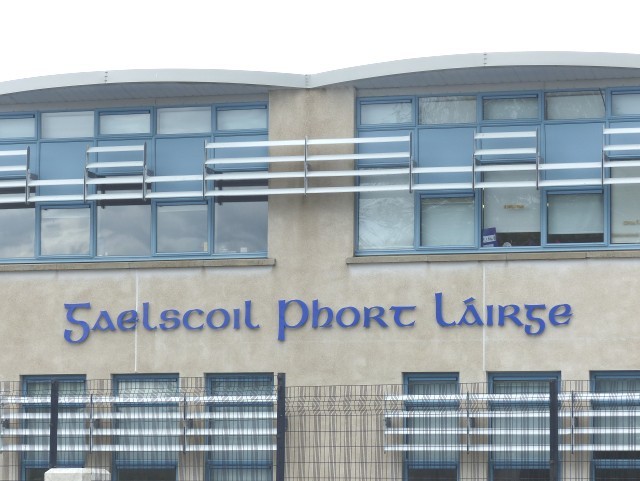
The Gaeilscoileanna are responsible for exposing individuals in their formative years to the Irish language with a broad reach of vocabulary covering normal subjects in primary and secondary schooling. This has definitely improved the standard of Irish among the population at large as is the reason why the early teen cohort in the country’s population is the one with the highest general knowledge of Irish as can be seen from the following graph.

There are naturally language issues connected with the Gaeilscoileanna. There are not enough Irish native speaker teachers in the country to service all the Gaeilscoileanna. So the pupils are overwhelmingly exposed to second-language Irish and this can vary greatly from school to school and from teacher to teacher. All too often pupils are lexically fluent but ignore entirely such basic aspects of Irish as the palatal/non-palatal distinction, the voiceless and voiced velar fricative and the gender of nouns. In such cases it is unlikely that the language will be carried forward when the pupils leave school. However, it should be mentioned that Irish may well be transmitted in future by non-native speakers outside the Gaeltacht who are committed to the language and dedicated to improving its status and use where possible. Many Irish scholars are of the opinion that it is this fluid, non-codified second-language form of Irish which will outlive native speaker Irish from the remaining speakers in the Gaeltacht areas.
For more information on Irish in education, go to the dedicated section by clicking here.
Commissioned study of Irish in the Gaeltacht
In 2004 the Roinn Gnóthaí Pobail, Tuaithe agus Gaeltachta ‘Department of Community Rural and Gaeltacht Affairs’ (as it was then called) commissioned a comprehensive study of the use of Irish in the Gaeltacht areas. This linguistic work was carried out by a group of scholars, chiefly Conchúr Ó Giollagáin and Seosamh Mac Donnacha, from the National Univerity of Ireland, Galway in cooperation with the National Univerity of Ireland, Maynooth (now Maynooth University). The results of this research were published in autumn 2007 as a comphrensive document, Staidéar Chuimsitheach Theangeolaíoch ar Úsáid na Gaeilge sa Ghaeltacht ‘Comprehensive linguistic study of the use of Irish in the Irish-speaking regions’ (552 pages).
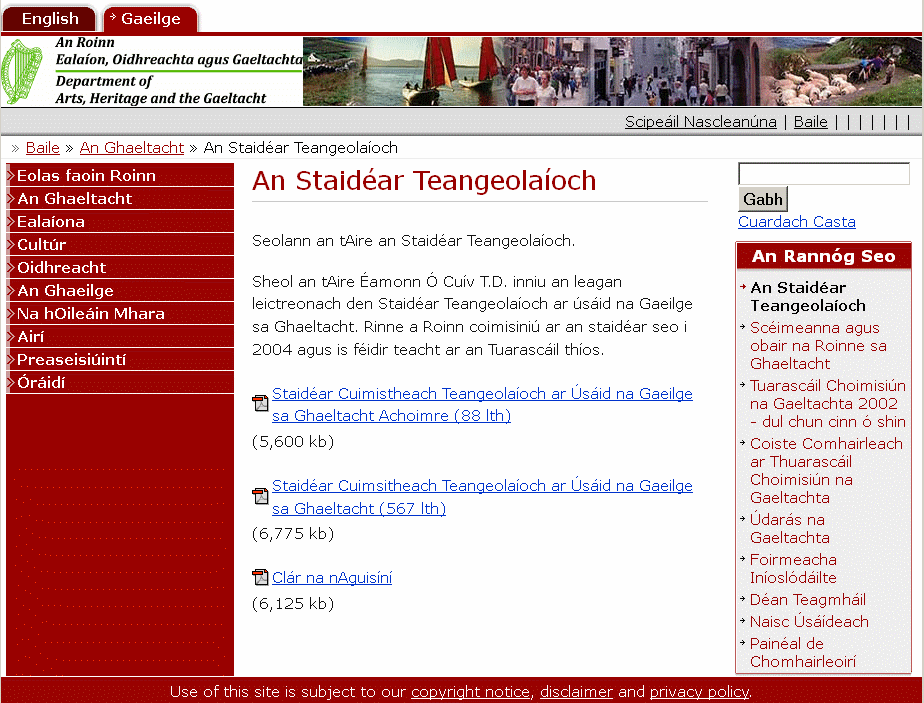
The report has a number of far-reaching recommendations, e.g. the division of each Gaeltacht into three categories, A, B and C, depending on the strength of the language there. This division would supersede the outdated one of Fíor-Gaeltacht ‘true Irish-speaking region’ and Breac-Gaeltacht ‘intermittent Irish-speaking region’. The number of people in Category A would be much less than in the present entire Gaeltacht. For instance, in Connemara, which is the most populous Gaeltacht at present, only 16,000 of 45,000 people would fall into Category A.
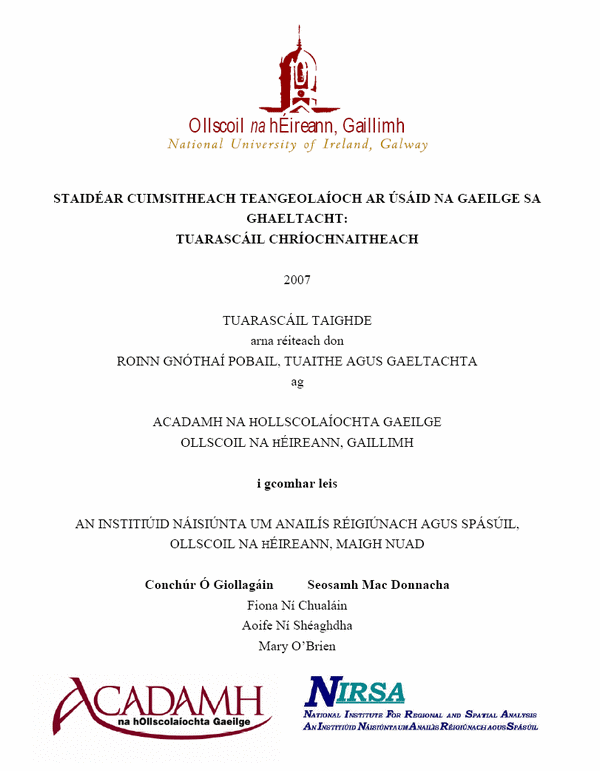
The report attempts to identify the reasons for language decline and makes suggestions to stem this. Chief among the reasons for the retreat of Irish is that young people – typically teenagers – who are growing up in Irish-speaking households very often do not use Irish amongst themselves, especially if there are English-speaking coevals with them. If this tendency was successfully counteracted then language continuity would be on a firmer footing and the future of the Gaeltacht areas would be more certain.
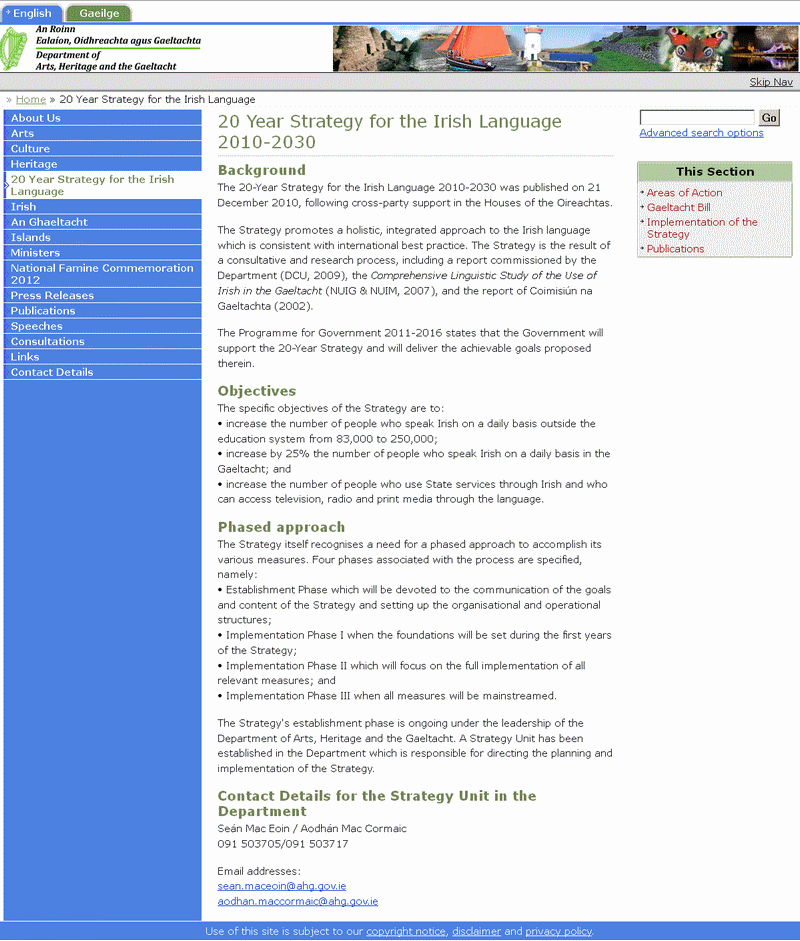
20 Year Strategy for the Irish Language 2010-2030
This is a strategy announced by the previous Fiann Fáil government in 2012 and is intended to coordinate efforts for the support and maintenance of the Irish language and its attending infrastructure over the next two decades. There is a government website laying out the objectives of the strategy accessible at, with an update from 2025: 20 Year Strategy for the Irish Language 2010-2030.
Revival movement for the Irish language

This organisation has been continuing active over more than a century and regularly organises events promoting the language, above all Seachtain na Gaeilge ‘Irish week’ which began in 1902 and was initially quite political in its orientation. It now two weeks of activities involving the language in all its diverse aspects taking place at the beginning of March and finishing at St Patrick’s Day (17th March).
.jpg)

For more information see:
Uí Chollatáin, Regina 2016. ‘Language Shift and Language Revival in Ireland’, in: Raymond Hickey (ed.) Sociolinguistics in Ireland Basingstoke: Palgrave Macmillan, pp. 176-197.
and, for some historical information about this movement, the government publication on the revival movement (on right).
.jpg)

